









Private Video Hosting vs Public Video Hosting: Which Is Better in 2026?
Publishing a video online is easy. Deciding where and how that video should be available requires more thought.
For some creators and businesses, maximum visibility is the goal. They want their videos searchable, shareable, and available to the widest possible audience.
For others, that approach creates a problem.
An online course may contain lessons intended only for enrolled students. A company may have training videos for employees. A membership website may offer premium videos to paying subscribers. A business may simply want its videos embedded on its own website rather than publicly discoverable elsewhere.
This is where the difference between private video hosting and public video hosting becomes important.
Both approaches can be useful, but they solve different problems. Understanding those differences can help you choose an infrastructure that matches your audience, business model, and content strategy.
What Is Private Video Hosting?
Private video hosting is an approach to storing and delivering videos where publishers maintain greater control over access and distribution.
Instead of publishing every video for unrestricted public discovery, content can be delivered within a more controlled environment.
Depending on the hosting platform, publishers may have access to features such as password protection, private video options, domain or embed restrictions, and geographic controls.
This makes private hosting particularly useful when the video itself has commercial, educational, confidential, or membership value.
A private video does not necessarily mean that only one person can watch it.
Thousands of authorized users could potentially view the same content. The important distinction is that the publisher has more control over how the content is distributed and accessed.
What Is Public Video Hosting?
Public video hosting takes almost the opposite approach.
The primary objective is usually making content easily accessible and potentially discoverable by a broad audience.
Public platforms can be useful for:
- Building an audience
- Marketing
- Brand awareness
- Entertainment
- Public tutorials
- Social engagement
- Search visibility
- Sharing content
For creators trying to reach as many new viewers as possible, public distribution can be extremely valuable.
The trade-off is that the platform itself may become a significant part of the viewer experience.
Your video may appear alongside recommendations, comments, advertisements, related content, or other features controlled by that platform.
That isn't necessarily bad. It simply serves a different objective.
The Biggest Difference Is Control
The simplest way to understand the two models is through one word:
Control.
Public platforms generally optimize for distribution and discovery.
Private hosting generally prioritizes publisher control.
Suppose you run an online course.
You probably don't want every premium lesson publicly searchable. You want students to sign into your website, open a lesson, and watch the video there.
Now consider a creator publishing a promotional trailer for that same course.
For the trailer, maximum public reach could be beneficial.
The same business can therefore have legitimate reasons to use both public and private hosting.
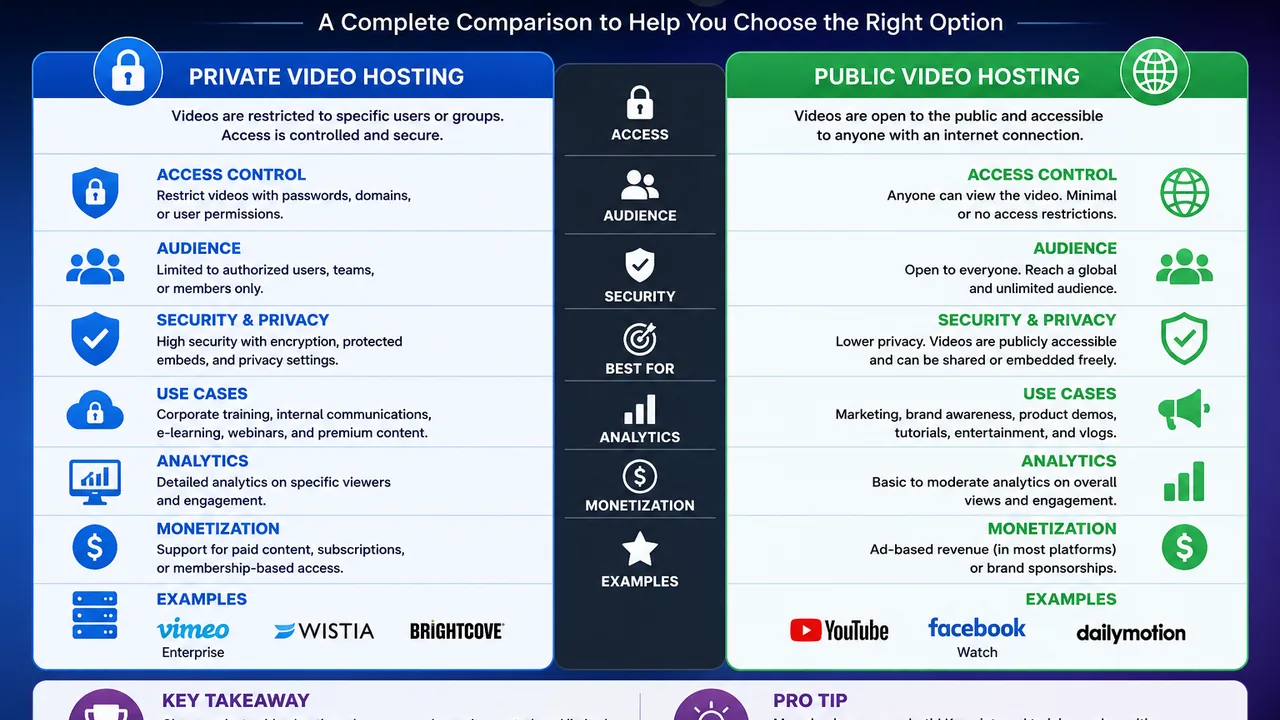
Private Video Hosting vs Public Video Hosting at a Glance
| Feature | Private Video Hosting | Public Video Hosting |
|---|---|---|
| Primary purpose | Controlled delivery | Public reach |
| Public discovery | Usually limited | Usually important |
| Website embedding | Often a core use case | Commonly available |
| Access controls | Greater emphasis | Often secondary |
| Membership content | Well suited | Less suitable |
| Online courses | Well suited | Better for promotional content |
| Marketing reach | Limited without your own audience | Stronger discovery potential |
| Viewer environment | More publisher-controlled | Platform-controlled |
| Internal business videos | More appropriate | Usually not ideal |
| Premium content | Better suited | Usually designed for public content |
Neither side of this table is automatically "better."
The right choice depends on what you're trying to accomplish.
When Private Video Hosting Makes More Sense
There are several situations where making content openly discoverable would work against the publisher's objective.
Online Courses
Course creators sell access to knowledge and educational content.
If premium lessons are freely available outside the course environment, the membership or enrollment model can lose value.
With private hosting, the course application can manage student access while the video infrastructure handles storage and playback.
The videos can then be embedded directly into individual lesson pages.
This creates a more controlled learning environment.
Membership Websites
Membership websites often use exclusive content as a reason for users to subscribe.
That might include:
- Premium tutorials
- Training libraries
- Exclusive interviews
- Recorded webinars
- Entertainment content
- Member-only educational videos
In these cases, public discovery isn't necessarily desirable.
The objective is to make the content conveniently available to authorized members.
Internal Business Videos
Companies increasingly rely on video for internal communication.
Training sessions, onboarding material, internal presentations, operational tutorials, and other company videos may not belong on publicly searchable platforms.
Private hosting can provide an infrastructure layer for delivering these videos through an internal portal or application.
However, organizations dealing with highly sensitive or regulated information should evaluate whether a provider's security and compliance capabilities meet their specific requirements.
Client Videos
Agencies, production companies, photographers, editors, and other professionals may need to share video previews with clients.
The goal isn't public discovery.
The goal is simply to let the intended client view the content conveniently.
Password protection or other restricted-access methods can be useful in these scenarios.
Premium Creator Content
Creators increasingly operate businesses beyond advertising revenue.
Subscriptions, memberships, courses, communities, and premium content can all form part of a creator's revenue model.
Public platforms can attract the audience, while private hosting can deliver material reserved for paying members.
This combination allows creators to use different infrastructure for different stages of the customer journey.
When Public Video Hosting Is the Better Choice
Private hosting isn't automatically the right solution for every video.
Sometimes you want as many people as possible to find the content.
Audience Building
If you're a new creator with no existing audience, restricting every video to your own website can make discovery harder.
Public video platforms already have large audiences.
Publishing useful public content can introduce your brand to people who may never have visited your website otherwise.
Marketing Videos
Some videos exist specifically to attract attention.
Product teasers, educational clips, brand stories, and promotional videos can benefit from being widely accessible.
Restricting this content could work against the marketing objective.
Public Tutorials
If the goal of a tutorial is organic reach, public distribution may be appropriate.
The tutorial can answer a user's question and introduce them to your brand.
Premium or advanced material can then be delivered separately through private infrastructure.
Do You Have to Choose Only One?
No.
In many cases, the strongest strategy is a hybrid approach.
Imagine an online fitness business.
It could publish short workout tips publicly to reach new viewers.
Those videos generate awareness.
The business could then offer complete training programs through its website, where paying members receive access to private long-form videos.
The public content becomes an acquisition channel.
The private content becomes part of the paid product.
The same model can work for:
- Education
- Software training
- Coaching
- Entertainment
- Business consulting
- Professional communities
- Creator memberships
Instead of asking whether public or private video hosting is universally better, ask which content belongs in each environment.
How Secure Is Private Video Hosting?
This requires a realistic answer. For more practical protection methods, read our guide on how to protect videos from unauthorized access covering access controls, domain restrictions, secure embeds, authentication, and other security layers.
"Private" should not be interpreted as "impossible to copy."
If an authorized user can watch a video on a screen, there are ultimately methods of recording what is displayed.
Private hosting instead focuses on controlling normal access and distribution.
Depending on the provider, this can involve technologies and features such as:
- Password protection
- Domain restrictions
- Embed controls
- Geographic restrictions
- Private links or access mechanisms
- Application-level authentication
The appropriate level of protection depends on the value and sensitivity of your content.
Publishers requiring these capabilities should evaluate a provider's secure video hosting features rather than relying only on the word "private."
For highly sensitive commercial media, additional technologies such as DRM or specialized enterprise security may also be required.
Why Domain Restrictions Matter
Imagine you operate example.com and embed premium videos on that website.
Without appropriate controls, another website may attempt to reuse an embed or otherwise distribute access outside the environment you intended.
Domain restrictions can provide an additional control by limiting where video playback or embedding is authorized, depending on how the provider implements the feature.
This is especially useful for publishers whose website is intended to remain the primary viewing destination.
It won't solve every possible content-protection problem, but it can make uncontrolled third-party embedding more difficult.
Password-Protected Video Hosting
Password protection is one of the easiest access controls for users to understand.
The viewer reaches the content and provides a password before being granted access.
This can work well for:
- Client previews
- Private presentations
- Limited-access events
- Small teams
- Temporary content sharing
For large membership applications, however, manually sharing passwords may not be ideal.
In those cases, the website's own authentication and membership system may need to manage user access while the hosting infrastructure manages video delivery.
Private Hosting and Embedded Video
One of the main advantages of private hosting is keeping the viewing experience inside your own website.
The visitor doesn't necessarily need to leave your domain to watch the content.
Instead, a player can be embedded into:
- Course lessons
- Premium articles
- Customer dashboards
- Member pages
- Product portals
- Internal applications
This helps keep the website or application at the center of the user experience.
A dedicated video hosting platform can provide the infrastructure required to upload and manage videos while allowing publishers to integrate playback into their own pages.
What About Streaming Performance?
Privacy isn't useful if the viewing experience is poor.
A private hosting solution still needs effective video delivery.
When evaluating a provider, test:
- Initial playback
- Seeking
- Mobile playback
- Long videos
- Different connection speeds
- Browser compatibility
- Player responsiveness
Modern video services may use technologies such as HLS to prepare and deliver content for online playback.
The hosting and privacy layer therefore needs to work alongside a capable video streaming platform.
Think of them as connected components:
Hosting manages the content.
Security controls access.
Streaming delivers the video.
The player presents it to the viewer.
A good user experience depends on all four working together.
Private Video Hosting for WordPress
WordPress websites frequently use video for courses, memberships, tutorials, and premium content.
Uploading every large video directly to the WordPress Media Library can create unnecessary storage and delivery demands on the same infrastructure running the website.
A dedicated video service provides an alternative architecture.
WordPress manages:
- Users
- Pages
- Memberships
- Courses
- Payments
- Content
The video platform manages:
- Video files
- Processing
- Streaming
- Playback infrastructure
The final player can then be embedded into the appropriate WordPress page.
This separation becomes increasingly valuable as the video library grows.
Private Video Hosting for Laravel and Custom Applications
Custom applications often require greater integration flexibility.
A Laravel application, for example, may already have its own user accounts, subscription logic, permissions, dashboards, and content database.
The application doesn't necessarily need to become the video-delivery server as well.
Instead, developers can integrate dedicated video infrastructure while keeping application-level business logic under their own control.
When choosing a provider for this type of project, API capabilities become particularly important.
Developers should evaluate whether the hosting platform can fit naturally into their existing workflow rather than requiring every operation to be performed manually.
Private Video Hosting for Paid Content
If viewers pay specifically to access your videos, content delivery becomes part of the product.
This changes how you should evaluate infrastructure.
The cheapest storage option isn't necessarily the best choice.
Consider the entire customer experience:
Can users start videos reliably?
Can they seek through long content?
Does playback work on mobile?
Can videos remain integrated into your paid website?
Are appropriate access controls available?
Can the platform accommodate growth?
A poor video experience can reduce the perceived quality of the entire subscription, even if the rest of the website is excellent.
Public Hosting Still Has an Important SEO Advantage
Public video platforms can provide something private hosting generally doesn't:
built-in discovery.
People search those platforms directly, videos may appear in recommendations, and public content can be shared widely.
Private videos embedded behind a login or membership wall won't have the same discovery characteristics.
This is another reason the hybrid approach can be effective.
Use publicly accessible content to answer questions, attract viewers, and build awareness.
Then use your website and private video infrastructure for premium or controlled content.
Don't hide content whose purpose is discovery.
And don't necessarily publish premium content openly when exclusivity is part of its value.
How to Choose Between Private and Public Video Hosting
Ask yourself these questions:
- Should anyone be able to discover this video?
- Is the video part of a paid product?
- Does the content contain private business information?
- Do I need the viewer to remain on my website?
- Do I need control over where the player is embedded?
- Is audience discovery more important than access control?
- Will users need to sign in before watching?
- Is the content intended for customers, employees, or members?
- Do I need additional security features?
- How important is branding and control over the viewing environment?
Your answers will usually make the appropriate model much clearer.
Common Mistakes to Avoid
The first mistake is assuming every video should be private.
Marketing content often benefits from public reach.
The second mistake is assuming every video should be public.
Premium lessons, internal material, and members-only content may require greater control.
Another mistake is treating private hosting as an absolute anti-copying solution.
Access controls can make unauthorized distribution harder, but they cannot guarantee that content visible to an authorized viewer will never be captured.
Finally, don't choose a hosting platform based only on today's requirements.
Think about where your video library and audience could be one or two years from now.
Is Private Video Hosting Worth It in 2026?
If your videos are simply public marketing assets, you may not need private hosting for all of them.
But when video has direct business value, greater control can become important.
Online courses, membership websites, businesses, SaaS applications, creators, and media publishers may all have content that shouldn't be distributed in exactly the same way as a public promotional video.
Private hosting gives these publishers another option.
Instead of choosing between "upload publicly" and "host everything yourself," businesses can use dedicated infrastructure to store and stream videos while integrating them into their own websites.
Final Thoughts
The choice between private and public video hosting isn't really about which technology is universally better.
It's about what you want each video to accomplish.
Public hosting is powerful when discovery, reach, and audience growth are priorities.
Private hosting becomes more valuable when access, embedding, premium content, business use, or greater control over distribution matters.
For many businesses, the ideal solution is to use both strategically.
Publish content publicly when you want people to discover it. Use private infrastructure when the video belongs inside your product, membership, course, business application, or controlled viewing environment.
If you're evaluating this approach for your own website, explore FileMoon's secure video hosting capabilities for protected and controlled video delivery.
You can also explore the broader video hosting platform for video management and the video streaming platform for online playback and delivery.



Comments (0)
No comments found