









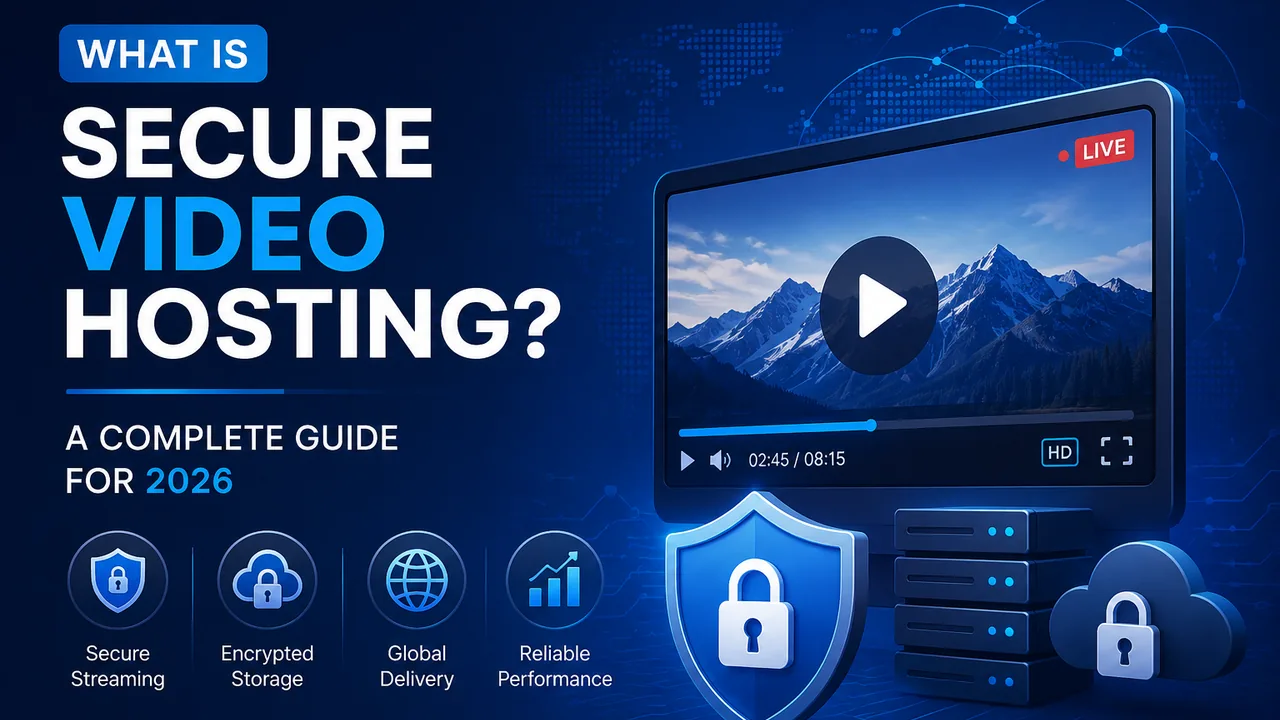
What Is Secure Video Hosting? A Complete Guide for 2026
Videos have become an essential part of online businesses, education platforms, membership websites, media projects, and digital content services. But uploading a video to the internet is only one part of the process. For many website owners and creators, the bigger concern is controlling how that video is stored, delivered, embedded, and accessed.
This is where secure video hosting becomes important.
Unlike basic public video sharing, secure video hosting is designed for situations where publishers need greater control over their content. It combines video storage and streaming with features that can help restrict access, manage embeds, protect private content, and provide a more controlled viewing experience.
In this guide, we'll explain what secure video hosting is, how it works, which features matter, and what you should consider when choosing a hosting solution in 2026.
What Is Secure Video Hosting?
Secure video hosting is a method of storing and delivering online videos while maintaining greater control over who can access the content and where it can be displayed.
A standard public video platform is usually designed to make content easy to discover and share. That can be useful for marketing, but it isn't always suitable for businesses or creators handling private, premium, educational, or members-only videos.
A secure video hosting solution takes a different approach. It can provide publishers with tools for managing access, controlling embeds, protecting videos with passwords or other restrictions, and delivering content through a dedicated video player.
For example, a course creator may want students to watch lessons only through an authorized website. A business may need to share internal training videos without publishing them publicly. A content publisher may want videos embedded on its own domain rather than sending viewers to a third-party social platform.
These are all situations where additional video-hosting controls become useful. If you are deciding which publishing model fits your content, see our comparison of private video hosting vs public video hosting to understand the differences in access, discovery, embedding, and content control.
For publishers looking for these capabilities, FileMoon provides a dedicated secure video hosting solution designed around controlled video delivery and online playback.
How Does Secure Video Hosting Work?
The process begins when a video file is uploaded to a hosting infrastructure rather than being served directly from the publisher's web server.
After the upload, the platform prepares the video for online playback. Depending on the service and source file, this may include processing or transcoding the video into formats suitable for different devices and network conditions.
The processed content can then be delivered to viewers through an embedded web player.
A typical workflow looks like this:
- The publisher uploads the original video.
- The hosting platform stores and processes the file.
- Streaming-ready versions of the video are prepared.
- The publisher configures available access or privacy controls.
- A player or embed code is added to the website.
- The viewer requests the video.
- The hosting infrastructure delivers the video according to the configured rules.
This separation between your main website and the video infrastructure is important. Instead of asking your WordPress, Laravel, e-commerce, or membership server to handle large video transfers itself, a dedicated platform handles the video-delivery workload.
Why Not Simply Host Videos on Your Own Web Server?
Technically, you can upload an MP4 file to a normal web server and place it inside an HTML5 video player. For a small number of videos and viewers, that may work.
Problems can appear as traffic and file sizes increase.
Video files are significantly larger than normal webpages, images, CSS files, and other website assets. Multiple viewers streaming large files simultaneously can consume substantial bandwidth and server resources.
Self-hosting also means you are responsible for several technical considerations, including storage capacity, video processing, playback compatibility, bandwidth, access controls, infrastructure scaling, and delivery performance.
A dedicated video hosting platform can move much of this workload away from the main website infrastructure.
This allows the website server to focus on serving the application or webpage while specialized infrastructure handles video storage and delivery.
Important Secure Video Hosting Features
Not every platform provides the same level of control. Before choosing a provider, it is important to understand which features actually matter for your use case.
Password Protection
Password protection provides a straightforward way to restrict access to selected content.
Instead of making a video openly accessible to everyone who reaches the page, a publisher can require authorized viewers to provide a password.
This can be useful for client previews, private presentations, limited-access videos, internal material, and other content that isn't intended for unrestricted public viewing.
Password protection should not be considered a complete digital rights management system, but it adds an important access-control layer for many common publishing scenarios.
Domain and Embed Controls
Embedding is one of the most useful features of professional video hosting, but publishers may not want their player embedded everywhere.
Domain-based controls can help determine where video content is allowed to appear.
For example, if your content is intended to be displayed on example.com, you may want to prevent unauthorized websites from simply copying your embed code and displaying the same player elsewhere.
This is particularly relevant for premium publishers, membership services and websites investing heavily in original video content.
Private Video Delivery
Some videos simply should not be publicly discoverable.
Businesses may have internal training material. Educators may provide lessons exclusively to enrolled students. Creators may publish premium videos for members or subscribers.
Private video hosting provides an alternative to publishing every video through an openly searchable public channel.
The exact implementation differs between platforms, so publishers should always evaluate the available privacy controls against the sensitivity of their content.
Geographic Controls
Online publishers sometimes need greater control over the regions from which content can be viewed.
Geographic restrictions can be relevant to licensing agreements, regional publishing strategies, internal business requirements, or content distribution policies.
When geographic controls are available, publishers can manage video availability according to their specific distribution requirements.
Secure Embedding
Embedding allows a video to remain part of your own website experience.
Instead of directing a visitor away from your website to watch content elsewhere, the player can appear directly inside an article, landing page, course lesson, dashboard, or membership area.
For businesses, this can provide a more consistent user experience and greater control over how video content fits into the surrounding page.
Secure Hosting and Video Streaming Are Closely Connected
Hosting a video and streaming it are related, but they are not exactly the same thing.
Video hosting primarily concerns storing, managing, processing, and making video files available online.
Video streaming concerns how that content is delivered to the viewer during playback.
Modern platforms often combine both functions.
One common streaming technology is HTTP Live Streaming, commonly known as HLS. Rather than treating an entire video as one large file that must be downloaded in a single operation, HLS can deliver video through smaller media segments.
This approach is widely used for browser and device playback.
A professional video streaming platform therefore complements the hosting layer by focusing on efficient playback and delivery to viewers.
Who Needs Secure Video Hosting?
Secure hosting isn't limited to one type of website.
Online Course Platforms
Educational businesses frequently publish content intended only for students.
A dedicated hosting solution allows the course website and video infrastructure to remain separate while lessons are embedded into the learning environment.
Membership Websites
Membership businesses depend on exclusive content.
If premium videos are a major part of a subscription, publishers generally need more control than a completely public video page provides.
Secure embedding and access controls can therefore become important parts of the membership architecture.
Businesses and Internal Teams
Companies increasingly use video for onboarding, training, presentations, demonstrations, and internal communication.
Not all of this material belongs on a public video-sharing service.
Private or restricted video hosting can provide a more appropriate environment for this type of business content.
Content Creators
Creators may have both public and premium content.
Public videos can be used for discovery and audience building, while exclusive videos can be delivered through a creator's own website or membership service.
Using different distribution methods for different content types gives creators more control over their publishing strategy.
Media and Video Websites
Video-focused websites can generate substantial storage and bandwidth requirements.
As the video library grows, managing those files on the same infrastructure as the main website can become increasingly complicated.
A dedicated hosting and streaming architecture makes it easier to separate video delivery from normal application workloads.
Secure Video Hosting vs Public Video Platforms
Public platforms and secure hosting platforms solve different problems.
Public video networks are excellent when the main objective is discovery. Their built-in audiences, recommendations, search functionality, and social features can help creators reach new viewers.
Secure video hosting is more appropriate when control is the priority.
A business may want the viewer to stay on its own website. A course creator may need private lessons. A publisher may want to control where its player can be embedded.
Neither approach is automatically better.
Many successful publishers can use both: public platforms for audience acquisition and dedicated hosting for private, premium, embedded, or business-critical content.
What Should You Look for in a Secure Video Hosting Provider?
Choosing a provider should involve more than comparing storage limits.
Start by asking how the platform handles the complete video lifecycle.
Can you upload and organize files easily? How are videos processed? Can they be embedded into your own website? Which access controls are available? How does playback behave on mobile devices? Can the infrastructure handle increasing traffic?
You should also consider:
- Video storage capabilities
- Streaming and playback technology
- Embed functionality
- Privacy and access controls
- Password protection where required
- Domain restrictions where available
- Device compatibility
- Upload workflow
- API capabilities for developers
- Scalability
- Account and file-management tools
- Pricing relative to your expected usage
The right choice depends on your project.
A small course website has different requirements from a high-traffic video publisher, and an internal business portal has different security requirements from a public entertainment website.
Does Secure Video Hosting Prevent Every Type of Copying?
No responsible hosting provider should suggest that online video can be made completely impossible to capture.
If content can be displayed to an authorized viewer, there are ultimately ways that the viewer may record what appears on their device.
The purpose of secure video hosting is therefore not to promise impossible protection. Instead, it is to provide meaningful controls that make unauthorized access, uncontrolled embedding, and casual redistribution more difficult.
For highly sensitive or licensed media, organizations may require additional technologies such as digital rights management (DRM), specialized authentication, watermarking, or enterprise access-control systems.
Understanding this distinction is important when evaluating any provider's security claims.
Is Secure Video Hosting Worth It in 2026?
For websites where video is an important business asset, dedicated hosting can be a sensible investment.
The biggest advantage is control.
Instead of treating every video as a public social-media upload, publishers can build video directly into their own websites, applications, membership systems, and content workflows.
It can also reduce the operational burden of serving large media files directly from a normal web server.
For a website with only a few public videos, a dedicated solution may not always be necessary. But as the video library, traffic, privacy requirements, or business value of the content grows, specialized hosting becomes considerably more useful.
Final Thoughts
Secure video hosting is about much more than finding somewhere to store an MP4 file.
A modern solution combines storage, processing, streaming, embedding, playback, and access controls into a video-delivery workflow that publishers can integrate with their own websites.
The most important step is choosing a platform based on your actual requirements. Consider who needs access to your videos, where those videos should appear, how much traffic you expect, and which security controls your content requires.
If your project requires private or protected video delivery, you can explore FileMoon's secure video hosting capabilities and determine whether they match your workflow.
For broader requirements, you can also learn more about FileMoon's video hosting platform and video streaming platform.



Comments (0)
No comments found